Source
My first contact with Mononoke did not feel like discovery, it felt like exposure. I was not entertained or eased into anything. I felt observed, measured, almost implicated. The series does not greet you or invite you in. It waits. It assumes you are capable of staying still long enough to notice what usually goes unnoticed. What struck me immediately was not fear in the conventional sense, but recognition. The kind that makes your body react before your intellect catches up. I realized very early that Mononoke was not interested in my comfort, my empathy, or my desire to like it. It wanted something else entirely. It wanted my attention in its rawest form, stripped of expectation and narrative reward. Watching it felt less like consuming a story and more like sitting through an examination I had not studied for, where the questions were not about plot but about moral posture, denial, and the quiet violence of looking away.
Rather than unfolding events in a way that reassures the viewer, Mononoke insists on a different rhythm, one that mirrors psychological processes instead of narrative ones. Truth is never revealed as a climax but as a burden. Every case follows a structure that feels almost procedural, yet deeply unstable, because what is being investigated is never just the apparition itself. The mononoke are not metaphors in the lazy sense. They are consequences. They exist because something human was left unresolved, unnamed, or intentionally buried. I found myself paying attention to pauses, to silences, to the way characters avoid certain words as if language itself were complicit. This is where the series becomes uncomfortable in a very adult way. It does not allow distance. It refuses the fantasy that horror comes from outside. Everything emerges from within systems we recognize. Desire, guilt, power, obedience. The supernatural is only the surface symptom of something already rotten.
Source
Something that kept pulling me deeper was how little the series cares about likability. The Medicine Seller is not a hero in any familiar sense. He does not save, redeem, or console. He diagnoses. He listens only as much as is necessary. He waits for truth to surface not because he is patient, but because truth always resists being named. There is no emotional release when a mononoke is finally confronted. If anything, the atmosphere becomes heavier. Resolution feels administrative rather than triumphant. Watching this as a woman, I could not ignore how often the emotional labor, the repression, and the social silence fall along gendered lines without ever being underlined. Mononoke trusts the viewer to notice patterns without annotation. That trust is rare. It assumes intelligence without flattering it. It never explains itself twice.
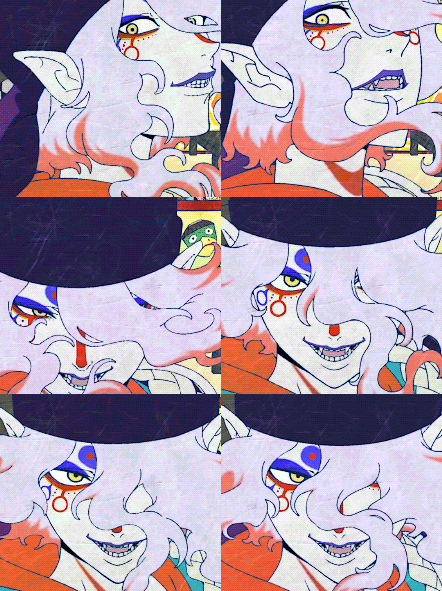
Long after individual arcs ended, what stayed with me was the sensation of being unsettled without spectacle. There are no cheap shocks here, no visual excess designed to jolt the nervous system. The visual style is striking, yes, but never indulgent. It functions as a form of estrangement, keeping me alert rather than immersed. I was constantly reminded that understanding comes at a cost. That seeing clearly is not a reward but a responsibility. This is where Mononoke separates itself from most psychological horror. It does not aestheticize suffering or turn trauma into narrative fuel. It treats it as residue. Something that lingers because it was never properly acknowledged. The horror is not what happens. The horror is what was allowed to happen and then politely ignored.
There is a temptation to frame Mononoke as intellectual or artsy, labels that often serve to soften the blow of difficult work. I resist that impulse. This series is not difficult because it is obscure. It is difficult because it is precise. It asks for honesty rather than interpretation. It does not want theories, it wants accountability. By the time I finished it, I did not feel impressed or emotionally drained. I felt quieter. More alert. Slightly uncomfortable in a way that did not fade. Mononoke did not give me something to talk about, it gave me something to carry. And that, to me, is the mark of horror that actually understands what it is doing. Not entertainment. Diagnosis.





Comments